

Sin categoría
5+ Breakthrough Insights on DMT in Mental Health Treatment and Clinical Research
Abr
Disclaimer: This content is for informational purposes only and does not constitute medical advice. Always consult a qualified healthcare provider before engaging with psychedelic substances for therapeutic use.
DMT in mental health treatment has gained significant attention in recent years for its powerful psychoactive effects and emerging therapeutic potential. Once relegated to the fringes of psychedelic exploration, DMT is now at the forefront of scientific inquiry, particularly in the context of mental health care. As the stigma surrounding psychedelics continues to shift, researchers, clinicians, and policymakers are increasingly recognizing the need for rigorous studies on how these substances may be harnessed for healing.
This article provides a comprehensive and balanced overview of the current state of DMT mental health treatment research. It explores the mechanisms through which DMT may exert therapeutic effects, highlights ongoing clinical trials, and evaluates both the promise and the limitations of existing evidence. We also discuss safety considerations, legal status, and how DMT compares to other psychedelics being studied for psychiatric use.
Among the most fast-acting psychedelics, DMT produces intense, short-lived experiences that can catalyze profound emotional and psychological shifts. This unique pharmacological profile positions DMT as a potential tool for addressing a range of psychiatric conditions—including depression, anxiety, PTSD, and addiction—especially when combined with psychotherapeutic frameworks. Early-phase clinical trials and neuroimaging studies are shedding light on how DMT affects the brain, the mind, and the therapeutic process.
If you are new to this compound, start with our foundational guide on what is DMT before exploring its therapeutic applications.
How DMT Works: Neurobiology and Mechanism of Action
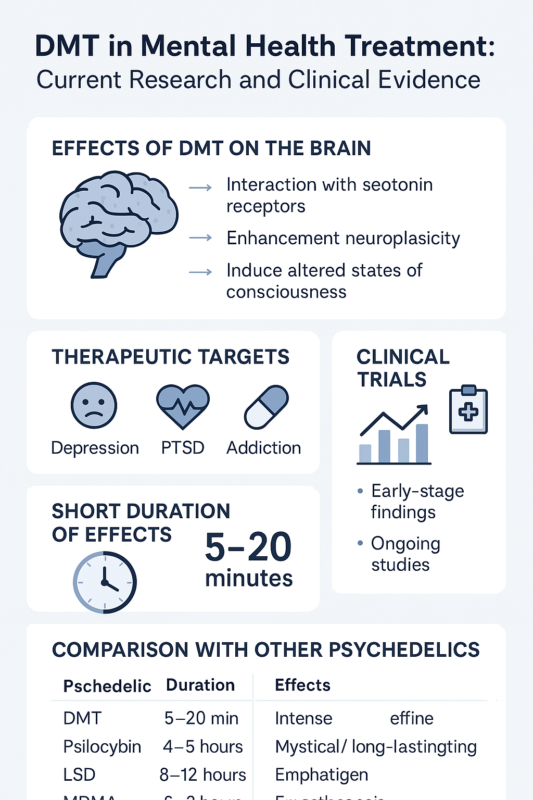
DMT interacts primarily with the serotonin system, especially 5-HT2A receptors, modulating perception, cognition, and mood. Its activity appears to:
- Enhance neuroplasticity – Promoting the growth of new neural connections
- Disrupt maladaptive default mode network (DMN) patterns – Linked to depression and rumination
- Induce transcendent, ego-dissolving experiences – Often associated with psychological breakthroughs
Unlike other psychedelics, DMT’s rapid onset and short duration (typically 5–20 minutes when vaporized) make it a candidate for brief, targeted interventions in clinical settings. For a complete timeline breakdown, read our guide on how long does DMT last.
The DMN is a network of brain regions active during self-referential thinking, mind-wandering, and rumination. Overactivity in the DMN is strongly associated with depression, anxiety, and obsessive thought patterns. DMT temporarily suppresses DMN activity while increasing connectivity between brain regions that don’t normally communicate, creating novel perspectives and breaking rigid thought loops.
Current Clinical Research on DMT in Mental Health Treatment
1. Depression and Treatment-Resistant Depression
Key Study: Small Pharma’s Phase I/IIa trial
Results: DMT-assisted therapy showed rapid antidepressant effects, with improvements noted within hours and sustained for up to 2 weeks.
Mechanism: Believed to rewire negative thought loops via enhanced synaptic plasticity and emotional processing.
Note: Unlike SSRIs, DMT does not require daily dosing, offering a potentially short-term alternative for some patients.
The speed of DMT’s antidepressant effects is particularly notable. While traditional antidepressants take weeks to months to show benefits, DMT can produce measurable mood improvements within hours of a single session. This rapid onset could be transformative for patients in acute crisis or those who have failed multiple conventional treatments.
For comparison, psilocybin mushrooms have also shown remarkable antidepressant potential in clinical trials. Read our article on how magic mushrooms can help with depression to understand the broader landscape of psychedelic depression treatment.
2. Anxiety Disorders and Existential Distress
Early-stage research is exploring DMT for:
- Generalized anxiety disorder (GAD)
- End-of-life anxiety in terminal illness
Mechanism Hypothesis: One proposed mechanism behind the therapeutic potential of the psychedelic experience—particularly with substances like DMT—is its ability to help individuals confront and reframe deep-seated existential fears. Under the influence of DMT, users often report a temporary dissolution of the ego and a profound sense of unity, timelessness, or connection with a greater reality. This altered state of consciousness can bring suppressed emotions, mortality fears, or spiritual concerns to the surface, allowing individuals to process them from a new perspective. This reframing may lead to lasting psychological relief, enhanced emotional resilience, and a deeper sense of peace or acceptance.
3. Post-Traumatic Stress Disorder (PTSD)
While MDMA dominates the PTSD conversation, researchers are also examining DMT’s role:
- Potential Benefit: Facilitation of reprocessing traumatic memories in a non-reactive, emotionally open state
- Current Trials: Mostly in preclinical or early human stages
The emotional openness induced by DMT may allow PTSD patients to revisit traumatic memories without the overwhelming fear response that typically accompanies such recall. In a controlled therapeutic setting, this could enable effective trauma processing that traditional talk therapy struggles to achieve.
Before considering DMT for any mental health condition, it is essential to understand contraindications. Read our guide on DMT and pre-existing health conditions to learn who should avoid this compound.
4. Substance Use Disorders
Ayahuasca studies, which include DMT, have shown promise for addiction treatment:
- Reduced cravings and use in alcohol, nicotine, and cocaine dependence
- Mechanism may involve emotional catharsis, insight generation, and enhanced motivation for change
Clinical-grade DMT (rather than ayahuasca) is now being tested in controlled lab environments to replicate these benefits more safely and consistently. The psychedelic experience often provides users with profound insights into the root causes of their addictive behaviors, creating lasting motivation for change that exceeds what traditional addiction counseling typically achieves.
How DMT Compares to Other Psychedelics in Therapy
| Substance | Duración | Legal Status (U.S.) | Primary Target | Notable Effects |
|---|---|---|---|---|
| DMT | 5–20 min | Schedule I | Depression, PTSD | Rapid insight, ego dissolution |
| Psilocibina | 4–6 hrs | Schedule I | Depression, anxiety | Mystical-type experiences |
| LSD | 8–12 hrs | Schedule I | Anxiety, OCD | Cognitive flexibility |
| MDMA | 6–8 hrs | Schedule I | PTSD, social anxiety | Emotional safety, empathy |
DMT is unique among classic psychedelics due to its extremely short duration of action. When inhaled or injected, the intense psychedelic effects typically begin within seconds and last only 15 to 30 minutes. This rapid onset and brief experience contrast sharply with the prolonged effects of substances like LSD or psilocybin, which can last for six to twelve hours.
The short duration of DMT may offer practical advantages in clinical settings, allowing for more flexible scheduling, reduced resource demands, and easier integration sessions. As a result, DMT-based therapies may be more accessible and efficient for both patients and practitioners. A therapist could potentially conduct multiple DMT sessions in a single day, something impossible with psilocybin or LSD due to their longer durations.
For those interested in longer-acting psychedelics, explore our articles on introduction to LSD as a therapeutic treatment y effects of magic mushrooms.
Delivery Methods and Clinical Safety
Modern studies often use:
- IV or IM DMT: For precision in clinical research
- Vape pens (investigational only): Being explored for non-invasive administration
If you are interested in vaporization as a delivery method, read our guide on DMT vape pens for a comprehensive overview of this format.
Safety Profile
When used in controlled settings, DMT shows:
- Low physiological toxicity
- Minimal long-term adverse effects
- Psychological discomfort possible (panic, disorientation)
For a full safety assessment, read our detailed DMT safety profile. You should also review DMT side effects to understand the full range of potential adverse reactions.
Important Caveats and Contraindications
While DMT is promising, it is not suitable for everyone—especially individuals with:
- Schizophrenia, bipolar disorder
- Severe cardiovascular conditions
- Current use of MAOIs, SSRIs, or stimulants
Review this crucial guide: DMT drug interactions
The interaction between DMT and psychiatric medications is particularly important. SSRIs can significantly blunt DMT’s effects while MAO inhibitors can dangerously intensify them, potentially leading to serotonin syndrome. Always disclose all medications to any healthcare provider before considering psychedelic therapy.
Legal and Regulatory Status
As of 2026:
- DMT is classified as a Schedule I substance in the U.S., meaning it is illegal outside research contexts.
- However, the FDA has granted “Breakthrough Therapy” designation to multiple psychedelic-based treatments, paving the way for accelerated approval.
- Researchers are optimistic that DMT-assisted therapy could follow psilocybin’s regulatory path in the next 3–5 years.
- Oregon and Colorado have created frameworks for regulated psilocybin therapy, though DMT is not yet included in these programs.
- Some cities have decriminalized personal possession of DMT, but this does not make it legal.
The legal landscape is evolving rapidly. What is illegal today may be available through prescription within the next decade as clinical trials continue to demonstrate safety and efficacy.
Expert Insights and Testimonials
“DMT may offer a scalable, fast-acting alternative for patients who don’t respond to conventional treatments.” — Dr. Robin Carhart-Harris, Neuropsychopharmacologist
“Its ability to induce rapid, profound shifts in perspective is unlike anything we’ve seen before.” — Dr. Rick Strassman, Author of DMT: la molécula del espíritu
These expert perspectives highlight why the medical community is increasingly interested in DMT’s potential. Dr. Carhart-Harris, head of psychedelic research at Imperial College London, has been instrumental in advancing the scientific understanding of how psychedelics affect the brain. Dr. Strassman’s groundbreaking research at the University of New Mexico in the 1990s was the first formal human study of DMT’s effects, laying the groundwork for today’s clinical trials.
DMT vs. Other Psychedelics: Which Is Best for Therapy?
Each psychedelic offers distinct therapeutic advantages:
DMT:
- Best for: Time-efficient sessions, rapid intervention, patients who cannot commit to full-day sessions
- Challenges: Intensity of experience, brief window for therapeutic work during peak
Psilocybin:
- Best for: Deep emotional processing, mystical experiences, longer integration period
- Challenges: Requires 6–8 hour session, more physically demanding
LSD:
- Best for: Cognitive flexibility, creative problem-solving, extended therapeutic dialogue
- Challenges: Very long duration (8–12 hours), potential for prolonged anxiety
MDMA:
- Best for: PTSD, relationship therapy, emotional safety and empathy
- Challenges: Not a classic psychedelic; different mechanism of action
For a detailed comparison between DMT and its close chemical cousin, read our guide on DMT vs. 5-MeO-DMT.
The Future of DMT Therapy
Several trends are shaping the future of DMT in mental health treatment:
Synthetic vs. Natural Sources: Clinical trials use pharmaceutical-grade synthetic DMT rather than plant-derived sources like ayahuasca. This ensures purity, precise dosing, and consistency—essential for medical approval. DMT therapeutic potential
Integration Technology: New apps and digital platforms are being developed to help patients prepare for DMT sessions and integrate insights afterward. These tools may become standard components of DMT-assisted therapy.
Group Therapy Models: Some researchers are exploring group DMT sessions, modeled after traditional ayahuasca ceremonies but in clinical settings. This could reduce costs and create community support.
Microdosing Research: While most clinical DMT research focuses on full doses, some investigators are exploring sub-perceptual microdosing protocols similar to those used with psilocybin. Read our microdosing magic mushrooms guide to understand this approach.
Preguntas frecuentes
Is DMT therapy legal?
No. DMT remains a Schedule I controlled substance in the United States and is illegal for therapeutic use outside of approved clinical trials. However, the FDA has granted Breakthrough Therapy designation to other psychedelics (psilocybin and MDMA), suggesting a path toward future medical approval for DMT as well.
How fast does DMT work for depression?
In early clinical trials, DMT has shown antidepressant effects within hours of a single session—far faster than traditional antidepressants, which typically take weeks to show benefits. These rapid effects may last for days to weeks, though more research is needed to confirm durability.
Is DMT safer than antidepressants?
DMT and antidepressants have very different risk profiles. DMT is not physically toxic and does not require daily dosing, but it can produce intense psychological experiences that may be traumatic if not properly supported. Antidepressants have well-established safety profiles for long-term use but carry side effects and require consistent daily intake. Neither is universally “safer”—they serve different purposes and populations.
Can DMT cure PTSD?
No substance “cures” PTSD, but DMT and other psychedelics show promise as adjuncts to therapy. DMT may help patients process traumatic memories in a non-reactive state, potentially accelerating therapeutic progress. However, it is not a standalone treatment and should always be combined with professional psychotherapy. DMT clinical research
How does DMT compare to ayahuasca for mental health?
Ayahuasca contains DMT plus MAO inhibitors that extend its duration to 4–8 hours. The longer duration allows for deeper emotional processing but also increases physical demands and nausea. Pure DMT (without MAOIs) is shorter, cleaner, and more predictable—advantages for clinical research. However, ayahuasca has decades of traditional use supporting its therapeutic applications.
What are the risks of DMT therapy?
Risks include psychological crisis (panic, paranoia, psychosis in vulnerable individuals), cardiovascular stress, dangerous drug interactions (especially with MAOIs and SSRIs), and psychological trauma from poorly supported experiences. For a complete risk assessment, read our DMT safety profile.
Will DMT be available by prescription soon?
Probably not before 2030. While research is advancing rapidly, DMT must complete Phase III clinical trials, secure FDA approval, and establish regulatory frameworks for clinical administration. Psilocybin and MDMA are further along in this process and will likely be approved first, potentially paving the way for DMT.
Can I use DMT for self-therapy?
We strongly advise against using DMT outside of clinical or professionally supported settings. The intensity of the experience, potential for psychological crisis, and lack of integration support make self-administration risky. If you are struggling with mental health, seek professional help through legitimate channels.
Conclusion: A Promising but Cautious Outlook
The therapeutic potential of DMT in mental health is no longer speculative—it is the focus of serious, ongoing clinical research. With its rapid action, neurobiological depth, and spiritual dimension, DMT may one day become a valuable tool in psychiatry.
However, we must distinguish between emerging evidence and clinical readiness. More large-scale, double-blind trials are needed before DMT can be widely adopted. The current evidence is encouraging but preliminary. Safety profiles, optimal dosing protocols, and long-term outcomes remain active areas of investigation. DMT mental health treatment
In the meantime, the most responsible path forward is research, regulation, and respect. For those interested in the broader psychedelic therapy landscape, explore our guides on how magic mushrooms can help with depression, microdosing magic mushroomsy introduction to LSD as a therapeutic treatment.
Related Reading & Products
If you found this article helpful, explore these related resources from our collection: DMT therapeutic potential
- What Is DMT? – A comprehensive introduction to the “spirit molecule”
- ¿Cuánto dura el DMT? – Complete timeline across all administration methods
- DMT vs. 5-MeO-DMT – Understanding the differences between these powerful tryptamines
- DMT Side Effects – Full breakdown of potential adverse reactions
- DMT Safety Profile – Medical and harm-reduction perspectives
- DMT Drug Interactions – Critical medication combinations to avoid
- DMT and Pre-Existing Health Conditions – Who should never use DMT
- Vape Pens DMT – For short-duration, breakthrough visionary experiences
- How Magic Mushrooms Help Depression – The most advanced psychedelic therapy research
- Microdosificación de setas mágicas – Sub-perceptual protocols for daily enhancement
- Introducción al LSD como tratamiento terapéutico – How clinical psychedelic research actually works
- Barritas de chocolate con setas – Explore our gourmet psilocybin edibles collection
- Shop All Products – Browse our full catalog of psychedelics

 Spanish
  English
  German
  Italian
  Finnish
  Dutch
Dutch  Portuguese
  French
  Swedish